
Sound is pretty awesome and versatile. Besides having an obvious role in music, two of the most notable uses are for lifting objects off the ground (sonic levitation) and for healing the body. And in this case I want to set your attention on the latter and the claims people make for its use in music.
432Hz and 528Hz are the most talked about examples of frequencies that heal “the body” and therefore, people say, “they should be used in music production” and “440Hz sounds dissonant and should be avoided”. And while I am 100 percent convinced that the aforementioned frequencies do in fact heal specific body parts, because I know what sound can do, I am of the not so humble opinion those “healing frequencies” are irrelevant in music. And not only is there nothing inherently wrong with 440Hz, but trying to avoid it is pointless. Here’s why:
Too Many Constantly Changing Tones
Sound therapy is about healing the body by focusing on a specific tone, one specific frequency, music is not. Music is about the relationship between frequencies and the balance of sound and silence. Those are two completely different things. If the tone 432Hz for example is to have any meaningful impact on the body you need to at least focus on it predominantly, which rules out music.
Because one of the reasons being a lot of music consists of chord progressions and melodies. If you tune the music to A=432Hz and a composition has four chords for example that ‘A’ note can most likely only be heard in one of the four chords. Two chords at the max mostly. And the second time that ‘A’ comes around it isn’t even the fundamental note anymore. The case in melodies is obvious, it consists of many different tones, not just one.
Trying To Avoid 440Hz Is Pointless
And then there’s the make up and timbre of instruments. It is possible with both physical and digital instruments to tune them to A=432Hz, but since 432Hz and 440Hz are so close together and no instrument is perfect and ever creates only one single tone, both frequencies are still obviously present.
Even with digital instruments, synthesizers that is the case. Because you don’t want to create a perfect tone, that gets boring very quickly. You want them to sound realistic and dynamic, which involves using unison effects, distortion, saturation, phaser and flanger effects, etc. That process creates many, many different additional frequencies. With the result of having both 440Hz and 432Hz frequencies in your instruments.
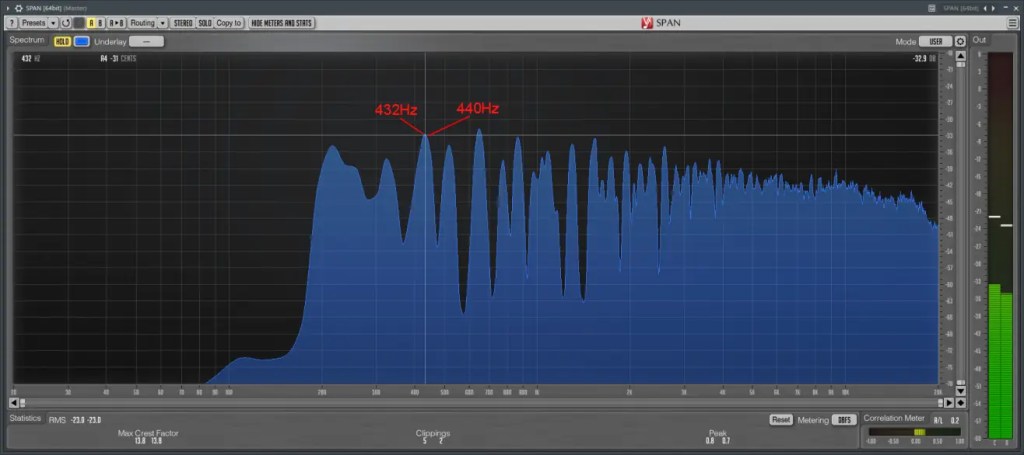
This is an image of a standard pad on the frequency visualizer. This pad includes all of the aforementioned effects, so it is constantly shifting frequencies, making it pleasant to listen to. It is tuned to A=432Hz. But as you can see 440Hz is present as well. It is the same with all these “432Hz healing music” tracks and videos you see online. The pads that are used contain all these effects which makes the sound “wobble” between frequencies. And that results in an audible 440Hz in addition to 432Hz.
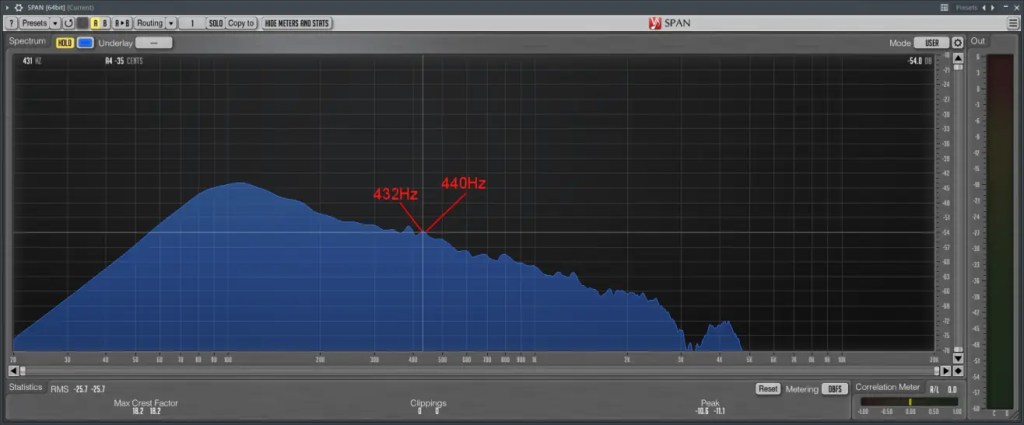
This is an image of one of my House kicks. For this example I have re-tuned it to A=432Hz and played it using the ‘A’ note. The basics of how a kick is made, is it very quickly sweeps the frequency spectrum from high to low. The make up of a kick consists of three parts; the transient or ‘click’, the ‘body or’ ‘punch’ and the ‘tail’. (It works the same with Toms and Snares by the way). In the case of this kick the transient is so fast that it already disappeared for the most part from the visualizer before I was able to press “hold”, but it is definitely there! The tail is the part that grabs your attention when listening, because it’s resounding the longest time. It is the ‘punch’ that makes a kick actually “kick” – which are the mid-range frequencies from about 1000 to 200Hz or so. In other words, even the kick alone occupies the entire audible frequency range! Which means 432Hz and 440Hz are both present in the sound.
So because there are so many different frequencies present in music, if you decide to re-tune your music to 432Hz, all you are doing is lowering the sound a bit and distorting how the producer or musician wanted the music to sound without any notable benefits.
Biased Towards A Warm Sound
When people do these blind tests where an instrument is played, once tuned to 440Hz and once to 432Hz, a lot of people say they prefer the 432Hz tuned instrument. And while there’s no accounting for taste of course, I am pretty sure the reason they say that is because most people prefer a ‘warm’ sound. A lower pitch makes it sound warmer. If someone were to create the same kind of test but with a tuning to A=432Hz VS A=426Hz or A=446Hz VS A=440Hz I am pretty sure they would say the same about the lower tuning in both cases as well.
In fact I remember seeing videos like that were musicians managed to trick people in that way. People thought they were choosing 432Hz while it was actually a different tuning. This is also why when people say “440Hz sounds dissonant” it can only ever mean it is “dissonant” with their preferences. Because objectively both tuning pitches have their positive influences and both sound equally dissonant when you play the wrong notes.
And what about these videos where people put sand or water onto plates and put a speaker underneath to make beautiful images? How come it reacts a certain way to certain frequencies? Well, the first question that needs to be asked is; what frequency is the plate made to resonate with? Because if you make it in such a manner that it resonates with a different frequency, you get different images.
Sound Is Arbitrary
The frequency of sound is measured in Hertz. Hertz is the new term for ‘Cycles Per Second’. Cycles Per Second is based on time. Time is arbitrary. That means sound is arbitrary. It may very well be that your body resonates and heals well with 432Hz based tones, but that doesn’t mean it’s a better frequency. Everyone has a different sense of time, a different body and is at a different stage of development. That’s why others may react well to 440Hz, 528Hz based tones and all the frequencies I haven’t mentioned.
An article written here features a more technical view of the three mentioned frequencies and why each may be beneficial to different people. It is one of the best objective views on this topic I have read. Mathematically there is a benefit to 440Hz just as there is to 432Hz. And there may be a good reason why 440Hz came along. (Always look at the bright side of life!)
In Other Words
I don’t see why I should care about having the “right tuning frequency” when instruments and sounds play both frequencies at once, the preferred tone isn’t played in chord progressions and melodies most of the time and music and time are completely arbitrary to begin with. I have nothing against different tuning standards, but the tuning I use is the one that simply sounds good to me. And that is the modern industry standard A=440Hz. If I were to describe this tuning standard I would use the words ‘clear’ and ‘fresh’. What matters though is using the 12 tone equal temperament system, so that music production is practical and not headache inducing. Besides that, sound therapy audio may technically influence the body more than music can, but well composed music does much more to raise my mood and consciousness than listening to a steady tone for an entire evening. And those who are familiar with the Law of Attraction and Synchronicity know that a high consciousness attracts well being in all its forms.
 Willem Hubertus
Leave a comment